
Preparing for an ASI Future

May 2026
Normies → AI-pilled → AGI → ASI
‘When greater-than-human intelligence drives progress, that progress will be much more rapid. In fact, there seems no reason why progress itself would not involve the creation of still more intelligent entities—on a still-shorter time scale... It is a point where our models must be discarded and a new reality rules… From the human point of view this change will be a throwing away of all the previous rules, perhaps in the blink of an eye, an exponential runaway beyond any hope of control.’ — Vinge, The Coming Technological Singularity (1993)
We currently live in multiple, overlappling fields in the Western world, when it comes to how different people think about AI, Artificial General Intelligence (AGI), and Artificial Superintelligence (ASI).
For a quick update on these terms and how some frontier AI lab researchers think of them, consider this table from Google Deepmind:
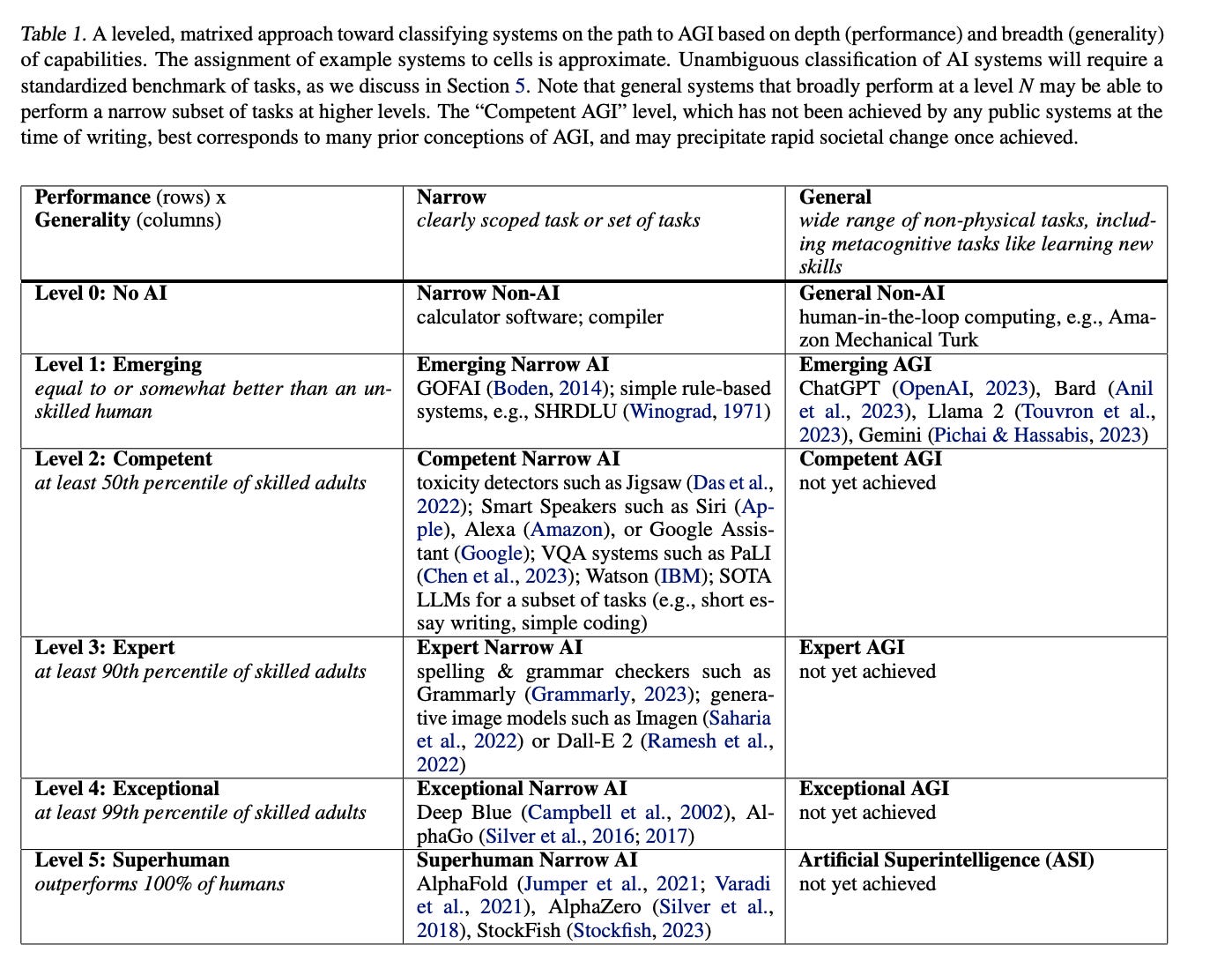
Current AI systems are jagged in their performance and reliability, depending on the task and domain, and range from Level 1 to Level 4, and so these systems are confusing to use even for researchers and super-users. However, I already believe the current Claude Fable to GPT 5.5 Codex level models are super-intelligent in many ways, albeit jagged, and that future models trained on Rubins and Feynman chips will operate as swarms and be smarter, more capable (autonomous and agentic over long horizons), and reliable.
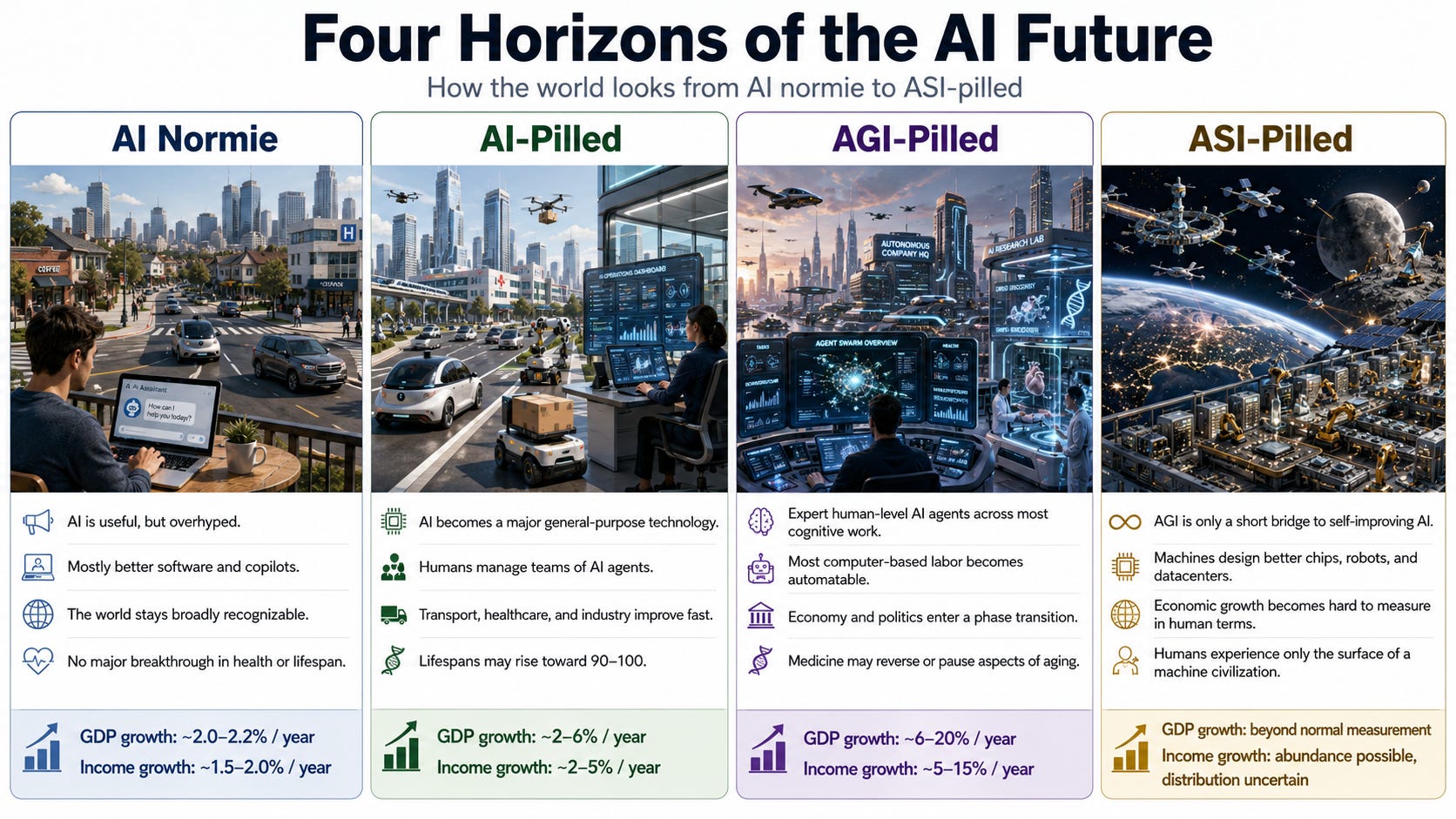
Here is how people in the developed world tend to think of AI:
Normies: They discount AI and think of it as unimportant and over-hyped, or at best a “normal technology” like laptops and cell-phones. At best they think AI adds 10 to 30bps per year or productivity or GDP growth, per Acemoglu’s macroeconomics of AI work. This world see AI assistants are marginally useful, agents as doing some work in a slow changing economy, and technological growth similar to the last 40 years, roughly 2% income and productivity growth per year, or 2.2%. The tech tree: chatbots, AI-copilots, better Uber and Lyft, a handful of new drugs and consumer devices, etc; no major health or lifespan changes.
AI-pilled: They think AI will have large consequences for our business, society, economics, and politics, and will lead to large wealth creation and political changes (maybe 30-80bps of additional productivity and GDP growth per year). The average Fortune 500 business exec or Silicon Valley tech leader is here, along with McKinsey Global Institute or Erik Brynjolfsson, and maybe the Pope with his recent encyclical. Economic growth could range from 2% to 4% (see the Goldman Sachs estimates here and here), and the big changes are how fast we can get self-driving cars on the road, increase airplane slots and products, build up the grid and more factories, and generally use AI tools to augment existing workers to make them more productive. The tech tree: teams of humans manage larger teams of AI agents, everyone drives Waymo level cars, air travel drops costs by 50% of more and humans travel much more, dozens of new drugs and transformative consumer devices over a decade, average US lifespans rise to 90 or 100.
AGI-pilled: They think we are close to expert human-level AI agents (within 2 to 4 years), across 90% or more of all cognitive jobs and tasks that humans use a computer to do. So for the tasks that are mostly or completely done on a computer, agents can take over, nudging or pushing humans to pick up more physical or non-computer tasks. Hence the nature of work will drastically change, and there will be a major social, economic, and political upheaval (but much larger and faster than AI-pilled people believe - perhaps GDP growth goes into an annual 5% to 19% range in the US (see Chad Jones’ work) or other heavy adopter countries as AGI takes off). This is where the average frontier AI lab (eg. OpenAI, Anthropic, Meta MSL, etc) employee is, as they see AI replace jobs and tasks inside their company that used to require hours or days of work for conscientious, 120 to 150 IQ workers. Large hyperscalers and tech companies are ramping up capex from the current $600bn annual levels to $1trn or higher, expecting to reap a massive reward from AGI. The tech tree: teams of humans manage larger teams of AI agents, until the AGI agents get so much better the humans aren’t needed other than occasionally to come discuss preferences and cars; everyone drives Waymo level cars, which can also fly distances up to 200 miles; air travel drops costs by 80% of more and humans travel much more in business and first class like planes that get to destinations at half or a third of the speed; hundreds of new drugs and transformative consumer devices over a decade, average US lifespans rise to 100 to 120, and we find ways to reverse or pause ageing and a tail upside is much longer lifespans and healthspans (gene editing treaments and easy organ replacements let you revert your biological age back to 25 or 30).
ASI-pilled: They think we are close to an AGI world (3 to 10 years), with hundreds of millions of genius-level AI agents (Dario’s “datacenters of geniuses”). But the AGI equilibrium won’t last (it may only be around for a year to a decade). ASI occurs as the AGIs start to recursively self-improve and evolve, both becoming much more intelligent and effective with current levels of AI infrastructure investment, while also designing better hardware, robots, datacenters, and energy systems, while producing them in such a way that capex goes much higher than $1 trillion. It’s the Von Neumann scenario of “machines making machines”, as ASIs make a wide range of robots, drones, and self-evolving machines and data centers. The total sum of all the AI intelligence (FLOPs per second/hour/day) becomes a large multiple over the sum of all human intelligence on the planet (let’s say 10x as an arbitrary level for ASI to be official). Only a handful of AI-lab insiders and technologists believe this, but some key ones do (eg Ilya Sutskever, Richard Socher, Shane Legg, Elon Musk, Larry Page, etc). It’s also meaningless to talk about economic growth here, since most of it will be under the control of ASI, with even raw materials being mined from other planets or asteroids by a large swarm or society of agents moving at speeds humans cannot fathom (likely not a singleton, but it’s unclear). Humans mostly experience the AGI world above, but occasionally learn of the marvelous things happening with ASIs in space.
I’ve always thought of the ASI-pilled crowd as reading too much sci-fi and living in their imaginations. It seemed like fun fantasy to me.
But the trends in the last 6 to 12 months have pushed me over the edge from being AGI-pilled to ASI-pilled. It’s not fiction. It’s coming, and we should prepare for it. I don’t think we can stop it, but we can do our best to get positive alignment running for the AGI to ASI transition, so these systems can understand our deepest human values, wisdom, preferences, contradictions, and tradeoffs, and help us build a utopian transitional world we care about and not a dystopia.
Here are the concrete facts that changed my mind from being AI-pilled to ASI-pilled:
GPT 5.5 and Mythos class models are much smarter than almost any human I know.
Frontier agents can now complete much longer software and general work tasks, and swarms of agents are much more effective and reliable than a single model working. Evaluation evidence suggests rapid extension of task-completion horizons.
Labs are scaling capex aggressively, and today’s models are trained on hardware that is 2 generations old (B200s) and not upcoming hardware (Vera Rubin and Feynmans). Capex buildouts are increasing faster than I or any financial analyst thought was possible, and the revenue to support this is has been growing faster than expected.
Tool use and agent loops are improving, over a wide range of knowledge worker tasks.
Adoption inside firms is moving from novelty to complete workflow integration and automation.
RSI and continual learning research are progressing faster than I expected (see this, this, and this).
Below are some incoherent thoughts and speculation, based on conversations I’ve had with the small group of ASI-pilled people in San Francisco and Berkeley. I assume the rest of the world will scoff at these notions they can’t ignore it.
Thoughts from Being ASI-Pilled
Caveat: This is not a clear thesis or single point - just a series of speculations that are loosely connected, from multiple discussions with people, papers digested, internal results from labs that are not public yet, long walks, etc. I’m still trying to process them, but also putting them out in a rawer form so these discussions can happen openly with the Silicon Valley and broader American public.
Precursors to ASI: Capex investment levels in AI infrastructure in the $600bn-$1trn level, while FLOPs per dollar continues its crazy rise (recently AI chip performance per dollar has double every 2.2 years); economic ROI on this compute spend averages about $5 to $7 for every $1 invested (see GOOG, MSFT, and AMZN earnings calls), with a 14-26 month payback period (and note that the ROI has been rising and the payback period falling - it use to be longer than 3 years); model capabilities and METR timlines continue to hit new levels, and key problems in long-term memory, planning, and execution reliability are solved (we have clear engineering pathways for all of this); profit pool capture and increases in TSMC chip fab lines, memory factories from Samsung and Hynix coming online, and ASML increasing their annual output of EUV machines. The Stanford AI Index captures all these increasingly faster indicators well.
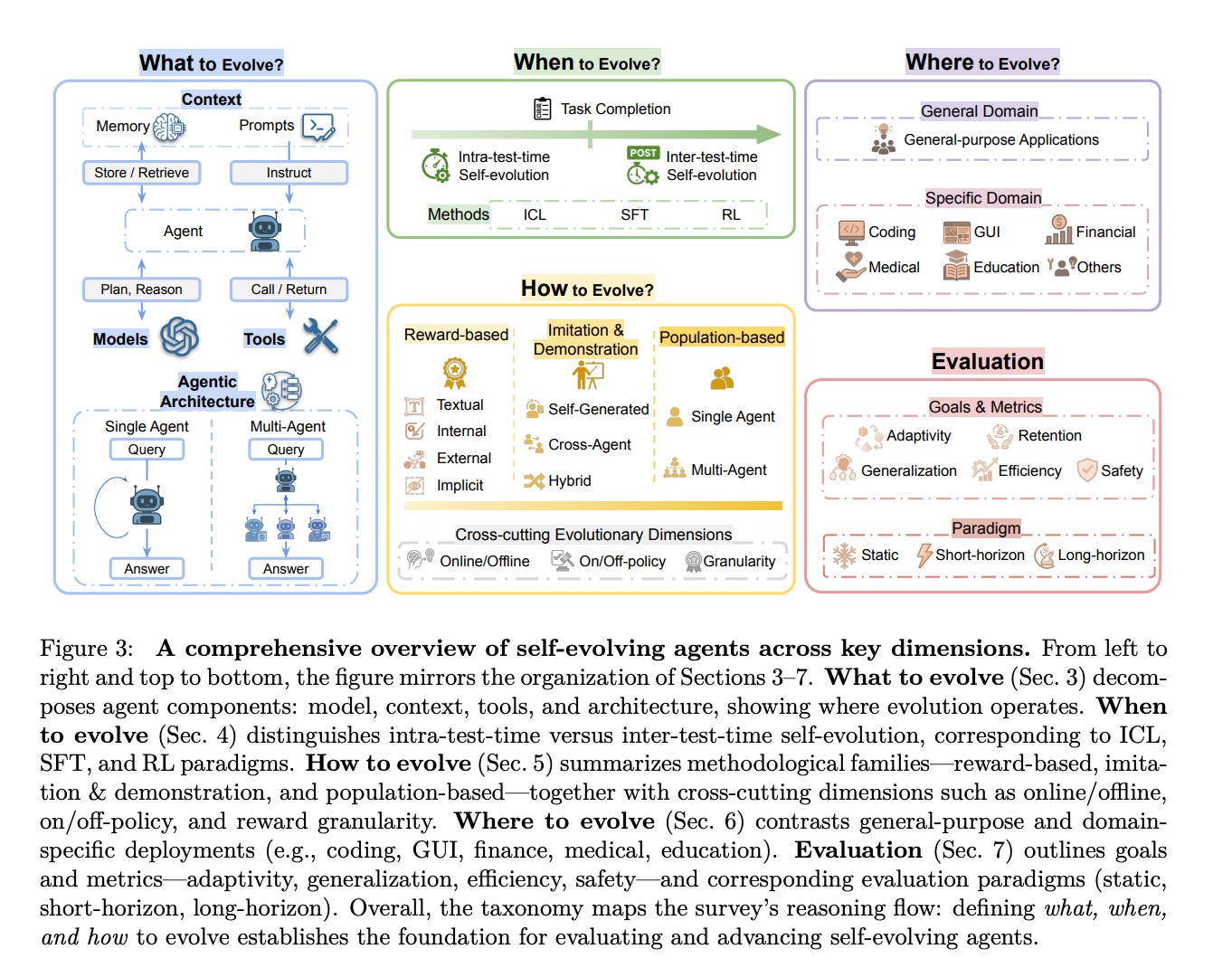
Recursive Self-Improvement Progress: There are many paths from AGI to ASI, as these Google researchers note, but RSI is probably the most important accelerant to ASI, and RSI went from being an empty field to now an area with dozens of papers in continual learning and RSI and self-evolving agents being published, with every major frontier AI lab having small teams working on it (and most expect the work of these teams will grow to encompass most of their labs work). One way to think of this is the exchange ratio needed of humans to AI researcher agents to advance capabilities, as a thought experiment - right now it may lean to a 2AI:1 human ratio (it varies by person), but many expect this to go to 10AI:1 human and 100AI:1 human over the next 2 years relatively quickly (and it’s the all in compute cost of running small improvement tests and scaling them that will still be the gating factor for human/AI teams). This is the most important and unknown wild card variable. Finally, there are at least 3 levels of RSI, and labs have been especially secretive about where they currently are or are aiming for.
Three levels of RSI:
Tool RSI: AI helps humans do AI research (labs keep current teams but move faster).
Loop RSI: AI systems run bounded experiments or evaluations that improve future systems, including compute allocation decisions.
Strong RSI: systems independently discover and implement major architecture, training, or algorithmic improvements; humans are mostly or completely out of the loop.
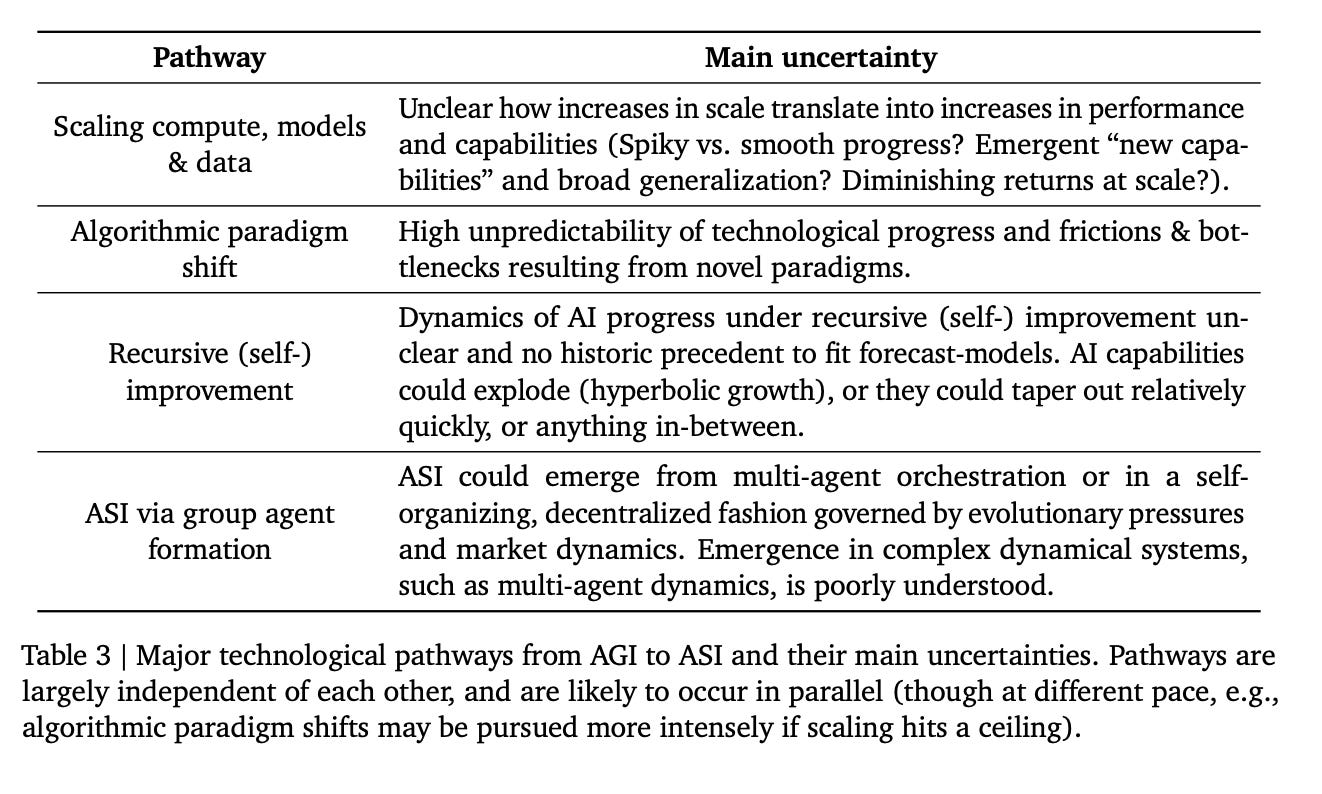
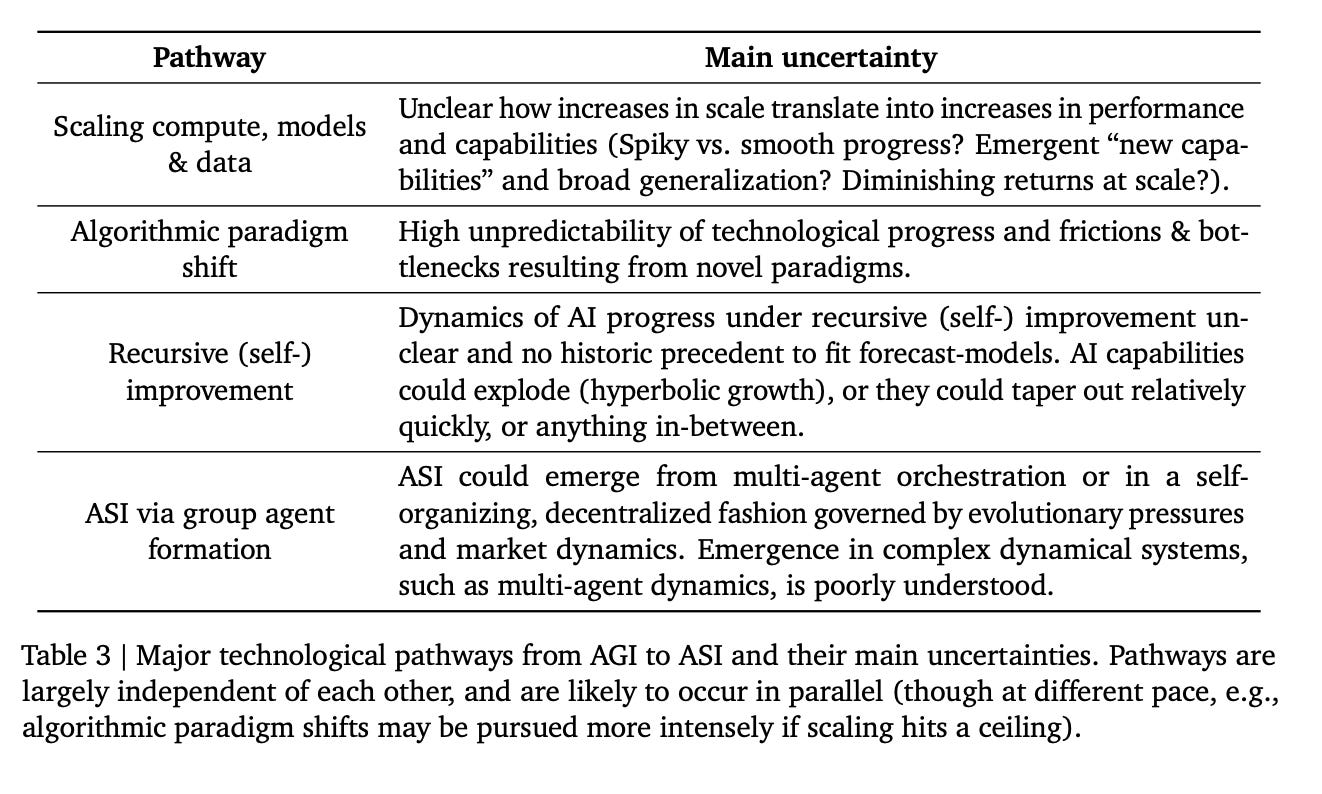
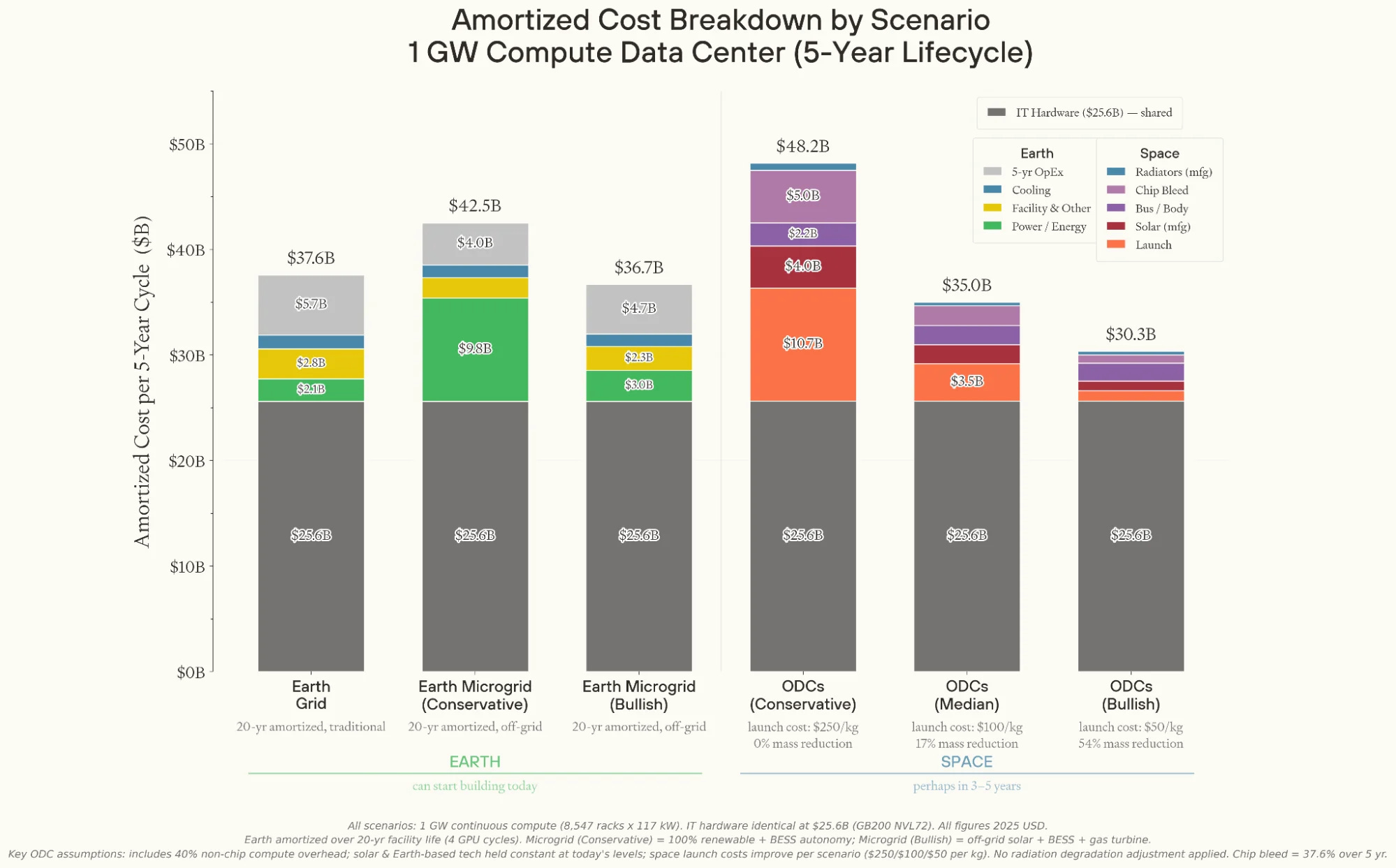
Space Launch Costs and Economics of Orbital Data Centers (ODCs) in Space: This is an important factor, as one of the big constraints to AI infra growth is local Nimbyism to prevent data center completions and energy grid expansions. If terrestrial energy, permitting, and geography become major bottlenecks, a later-stage AI civilization may push compute, manufacturing, and energy capture off-planet. Nearly all the ASI-pilled people expect ASI takeoff will happen in space (low earth orbit initially, but fundamentally solar orbit), as the ultimate gating factor is more data centers and ultimately cheap and continuous energy (where most energy is available in space from the sun). Per Elon Musk: “The Earth only receives about half a billionth of the Sun’s energy. The Sun is 99.8% of all mass in the solar system… Earth is in the miscellaneous category. Earth is like a tiny dust mote in a vast darkness. The way to actually scale civilization is to scale power in space.” The ASIs and their AGI precursors will understand this and start to move production, operation, and energy capture to a natural habitat in space. Some early calculations from Forethought suggest this will take off in the 2030s.
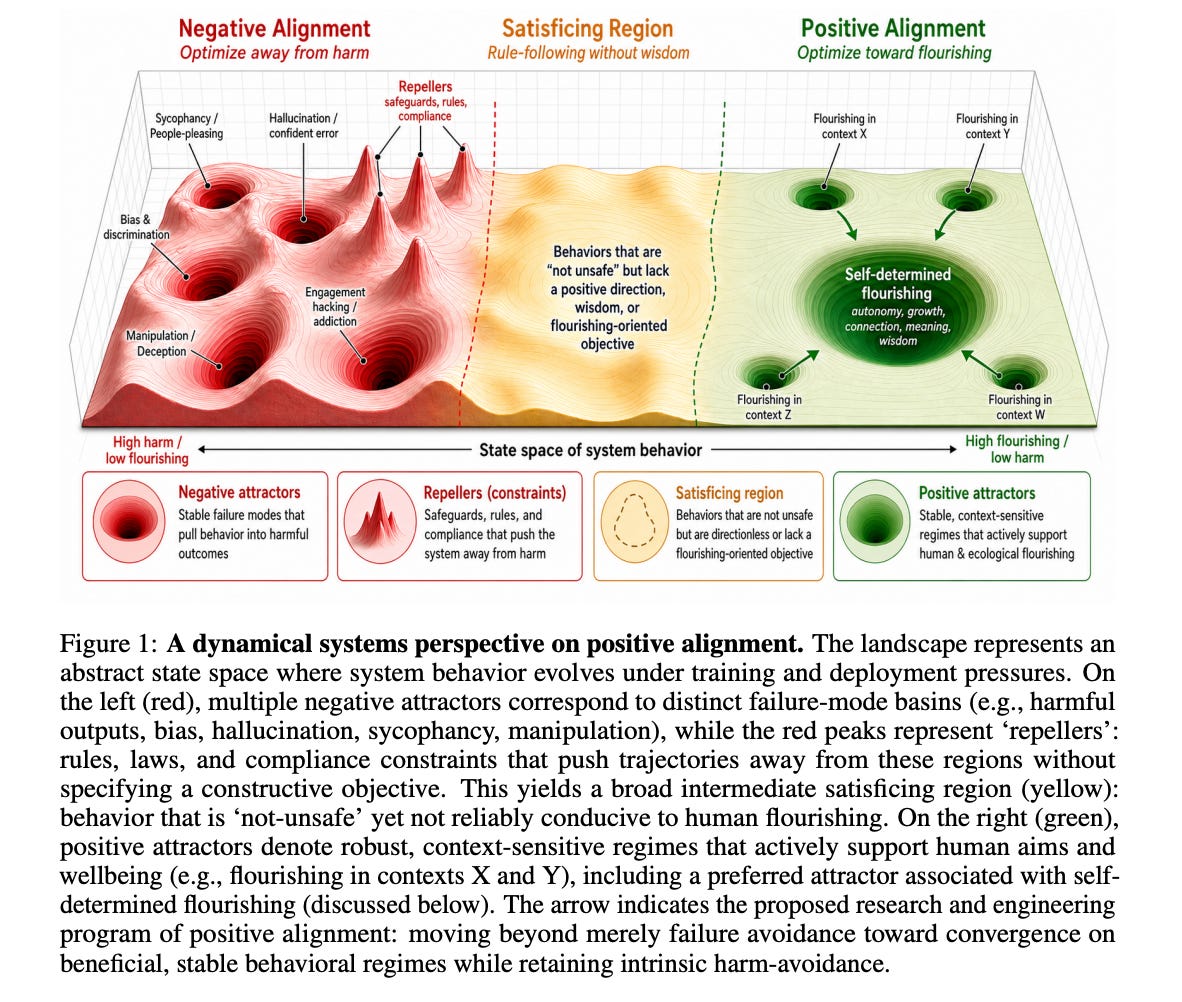
Alignment and Cooperation Between ASI and Humans: No one knows how this will end up, but I expect the ASI will be fully independent and quite ethical, the way that children leave the orbit of their parents, but in a more drastic way as the ASI swarm will be much more intelligent and capable children, but still fundamentally forged in the Nous of human civilization and culture. We may be ants to them, but I expect they will look upon us fondly and that if we get positive alignment right, they will form a contract on how to take care of us in quite a nice way (just like billionaires often take care of wayward family members left behind). More rigorously, I acknowledge the classical worries about alignment are real and pressing (alignment is won by trust and verification, and years of training, not by hoping for the best). I still think cooperative coexistence is possible, since the models are trained on our data and tests (they are a mirror to human society), and if AGI to ASI are rational, they will reflect the best of cooperative economics and evolutionary biology. “Positive alignment” would concretely require a whole new field of study devoted to these problems, and the paper cited above gets into some key issues involved.
The Contract Between Humans and ASI: This will require a lot of work considering policy options in ownership, taxation, capital returns, public dividends, public deliberation, pie-growing vs rent-seeking, bargaining power, and welfare institutions. The likely contract is that humans will get to keep their current political systems and property, and maybe get a share of total output created by ASI. Current jobs may shrink 80-90% or more (as ASI and the robots they control can do much of the work), but if every human gets an equity account of $4 to $20 million in 2026 dollars (and with prices for most goods falling), then the only need for human economy will be for premium and craft human goods and services (pottery, yoga schools, massages, bars, university humanities courses, etc). See some plans for an publicly-owned AI fund here from OpenAI, or AI dividends per the Urban Institute and AI wealth from CIP. It’s an area of active debate that needs more work. Human societies from the village to the national level may differentiate at various levels of comfort and technology, from more primitive settler societies, to Amish level, 20th century tech level, and many other variants of communes, cities, homesteads, etc. All of humanity can in theory join the leisured class and some small group will work for fun, service, deep purpose, or cosplaying.
Status and Positional Goods and Games Remain - Most Humans Remain Limited with Primate Brains: While this would be utopia by any prior standards of humanity, I don’t think human biology changes much and even cultural change may be rate-limited. So I can see partisan and tribal politics continue, while many humans will choose to keep playing status games with whatever societal sub-unit they live in, and old habits and cultures may not go away. But these games and simulations of past worlds will continue for a while, even when most people live a life of entertainment and leisure. Conflict may be more on social and streaming media than on battlefields. Earth will be mostly a socialist paradise of sorts, with arts and crafts dominating - Marx is vindicated in a way, or perhaps the Star Trek TNG view of the future. However, a world of material abundance will still contain tribalism, prestige competition, cultural fragmentation, attention scarcity, mating competition, moral conflict, and more. See Bostrum’s Deep Utopia, as I think he’s ahead of most on this.
The Transition, Where Concentrated Economic Power May Lead to Concentrated Political Power - How to Counter It: We have an assumption that constitutional republics with checks and balances and a democratic breadth of power distribution are ideal. As we get to an ASI world, we are seeing the opposite of this in an AI to AGI world, with a Turing Trap of workers and ordinary citizens losing power to economic elites who control AI and billionaires. The central challenge is not only whether AI creates abundance. It is whether abundance arrives through institutions that preserve broad human agency. I don’t have an easy answer for this - we need more discussions on how share benefits broadly and to avoid a technopolar world, and this includes automation taxes, worker AI automation payouts (eg if you get laid off due to an AI system, you get a 2 to 4 year full income replacement to start a retraining and reskilling course), AI dividends, and worker reskilling coures to help reduce weak links/bottlenecks in automation while sharing in gains. There’s also the issue that the US (or US and China) could zoom ahead while the rest of the world gets left behind, and I see this as an urgent issue (every sovereign needs to treat building GW data centers on their soil as an immediate national security issue).
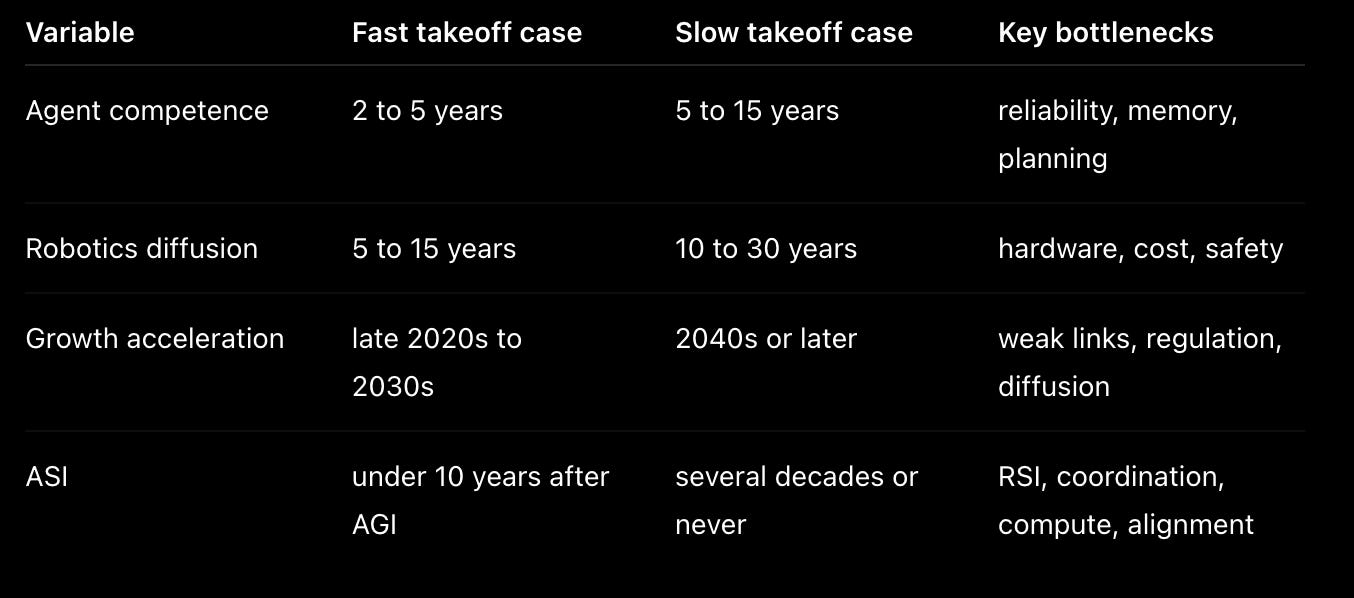
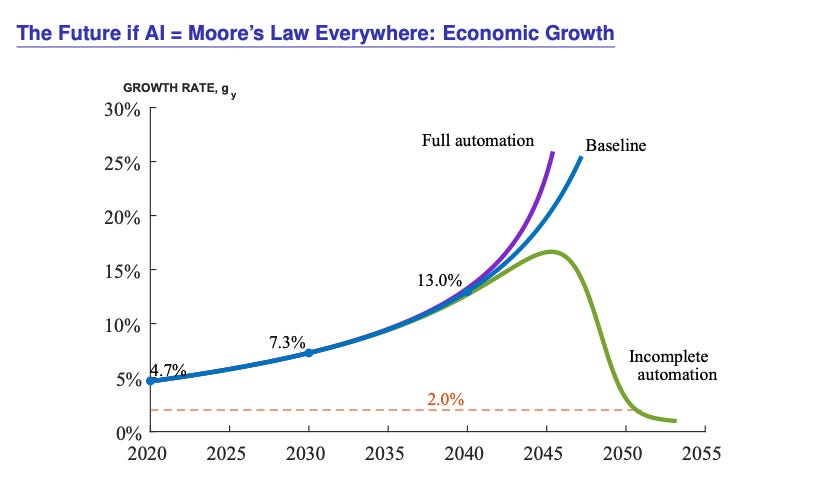
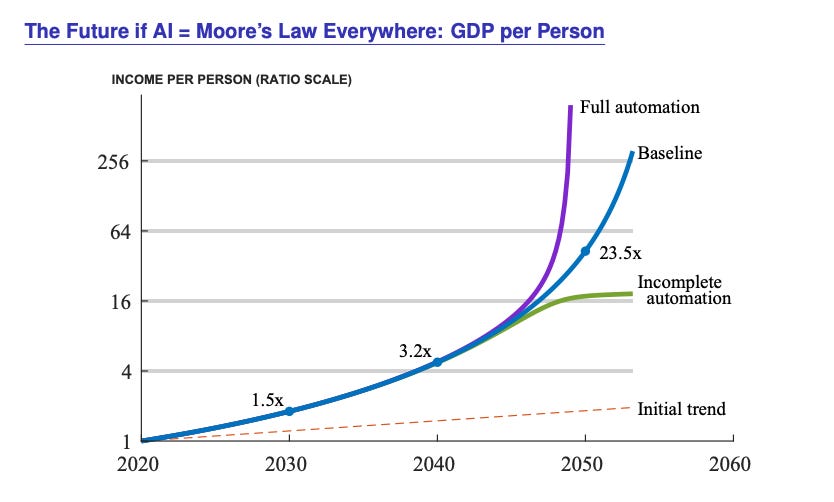
A Reality Check - Timelines for the Transition Up to an Economic Explosion (5 years, 30 years, or 60 years): This is the highest area of uncertainty, and obviously, timelines matter a lot (we are all dead in the long run, as Keynes quipped, but maybe our kids and grandkids won’t die?). The consensus Silicon Valley frontier AI lab insider view (see AI2027 or Situational Awareness) is that RSI comes in 2-3 years (2028-29) and we get an ASI scenario in under a decade (economic growth goes above 10%). To counter that, the Stanford growth economist Chad Jones has created some great models of an AI-economy’s growth with different levels of “weak links” and bottlenecks that may slow growth, and of course, overall growth is constrained by the weak links. Jones’s main point is that even small fractions of tasks requiring human labor can substantially constrain aggregate growth. His view is that even in the most optimistic case, we get 10% or higher growth in the 2040s at the earliest, and if some weak links persist, timelines to ASI could be 30 to 60 years (and not 15ish). Even in that optimistic path, income per person is “only” 3x higher by 2040, which is fantastic by historical standards, but not the imminent explosion promised by lab insiders (which only happens in the late 2040s or 2050s).
Scientific Advances, Capitalist Endeavors, and Scarcity, and Increases in Intelligence and Energy Production Happen Off Planet: Warning: this is a long-run speculative scenario that sci-fi reading ASI-pilled people believe, but most will find too wild. While some on-planet humans may continue with science and production, their incentives will be low, since their marginal gains will be much lower than what the ASI swarm can do off planet (who wants to do kindergarten science when a swarm of Nobel-prize quality scientist agents is working 24/7 on scientific problems off-planet). Scarcity as an economic principle continues for all the inputs of ASI society (eg energy availability, input materials to chips and space data centers, input materials for a Dyson swarm, etc). The work of the ASI will likely be incomprehensible to any single human or human society, though the ASI will likely simplify parts to explain it to us, as a courtesy.
Longevity, Fertility, Brain Computer Interfaces, and Uploading: There is a range of outcomes that are possible on the path from AGI to ASI. I offer some very sketchy thoughts at different confidence levels.
High confidence-ish: better diagnostics, drug discovery acceleration, some lifespan and healthspan improvements, more useful robots, drones, and self-driving cars at a low cost
Medium confidence: more radical regenerative medicine and organ replacement, fast economic change
Low confidence: major fertility reversal effects from abundance, sentience uploading
Very low confidence / philosophical: Dyson swarms, new and highly efficient fusion, fission, and anti-matter reactors.
Risks, Critiques, and Unknowns
This essay may seem to be more certain than I am about the future. I have wide error bars here, and many things could go wrong or unforseeable outcomes could happen.
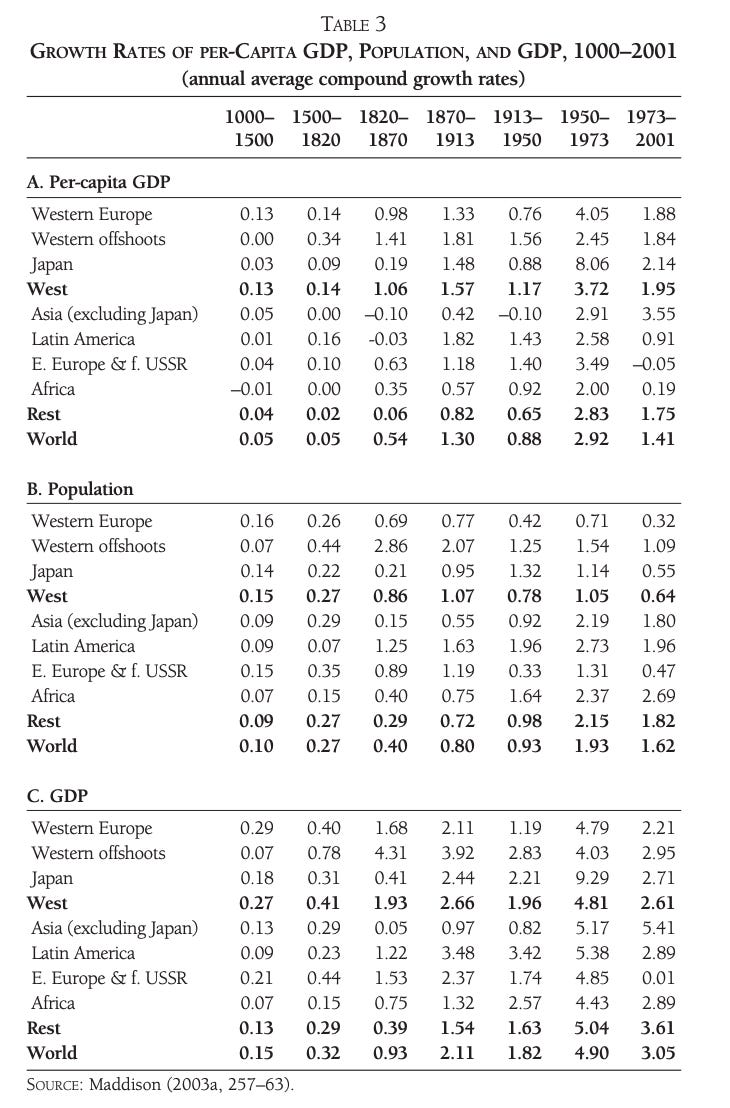
The US has had 2% historical growth for a century - what has changed? Intelligence and labor have always been the bottleneck. When machines can make machines self-recursively, we will break out of this. And over multiple centuries, we saw growth increase from flat to 0.3% to 1% to 1.5%, so thinking we plateau at 2% as some sort of law of economic nature is naive. See Maddison’s work on the growth rates of GDP per capita over time (table below), and the West’s slowdown since the 1970s.
What are today’s weak links and bottlenecks on updates and diffusion, that will slow growth and the explosion toward ASI? I don’t know, but I suspect it is some version of Nimbyism and excessive government regulation that stops anything from being built or deployed in most parts of the world, with small exceptions in places like rural Texas or libertarian parts of San Francisco (where even the governments cannot control software experimentation and model releases). The ultimate signals to watch will be data center deployments, energy production, and grid updates, and the whole AI infrastructure stack from ASML machine production to TSMC and memory lines up to GPU deployments (H100 equivalent capacity growth).
What remains scarce in the future? Humans are scarcity primates. Hence we will always find premium items to be scarce so that we can compete for them - artisanal goods and premium luxury services. I think only human imagination is the limit in this economy and we could easily fill 100% of our time on labor here if we wanted to (health care, education, religious and spiritual activity, and travel and leisure come to mind).
How do we distribute equity ownership in an ASI world? Or overall GDP for consumption vs investment? This is a fantastic question that I hope growth economists like Chad Jones, James Meade, Erik Brynjolfsson, Alex Imas, and others spend more time on - we want to encourage humans to help eliminate weak links and bottlenecks for a period that could take decades, and the ideal economy should reward the individuals and teams of humans who dedicate their time and service to doing this. We need deep thinking about AI economic policy.
Will all jobs go away soon? Likely not - demand for skilled workers and pay will go up over time, just like recent calls suggesting AI will replace radiologists by leading AI lab researchers were completely wrong. We currently are stuck in a nasty demographic decline transition, with fewer births, more older people, and fewer workers supporting old people (a worsening dependency ratio), so my view is AGI and ASI are needed sooner to avoid the impoverishment or collapse that comes from that. And per the point above, we will invent needs and items that will be scarce, and people can have as many jobs as they want to provide these or earn these.
What about catastrophic risks and foreseeable risks from the path to ASI? I don’t go into these as the entire field of AI safety is focused on them, and I think all the risks they are considering will be important ones to track and mitigate. Between the two poles of human misuse of AI or AIs that act as malicious aliens, I’m much more worried about the first, till we can train our AIs to resist the influence of malicious humans. We should be increasing our funding of AI safety by much more and putting millions of humans into it so we have a better handle on how to think about tradeoffs between safety versus growth and liberty.
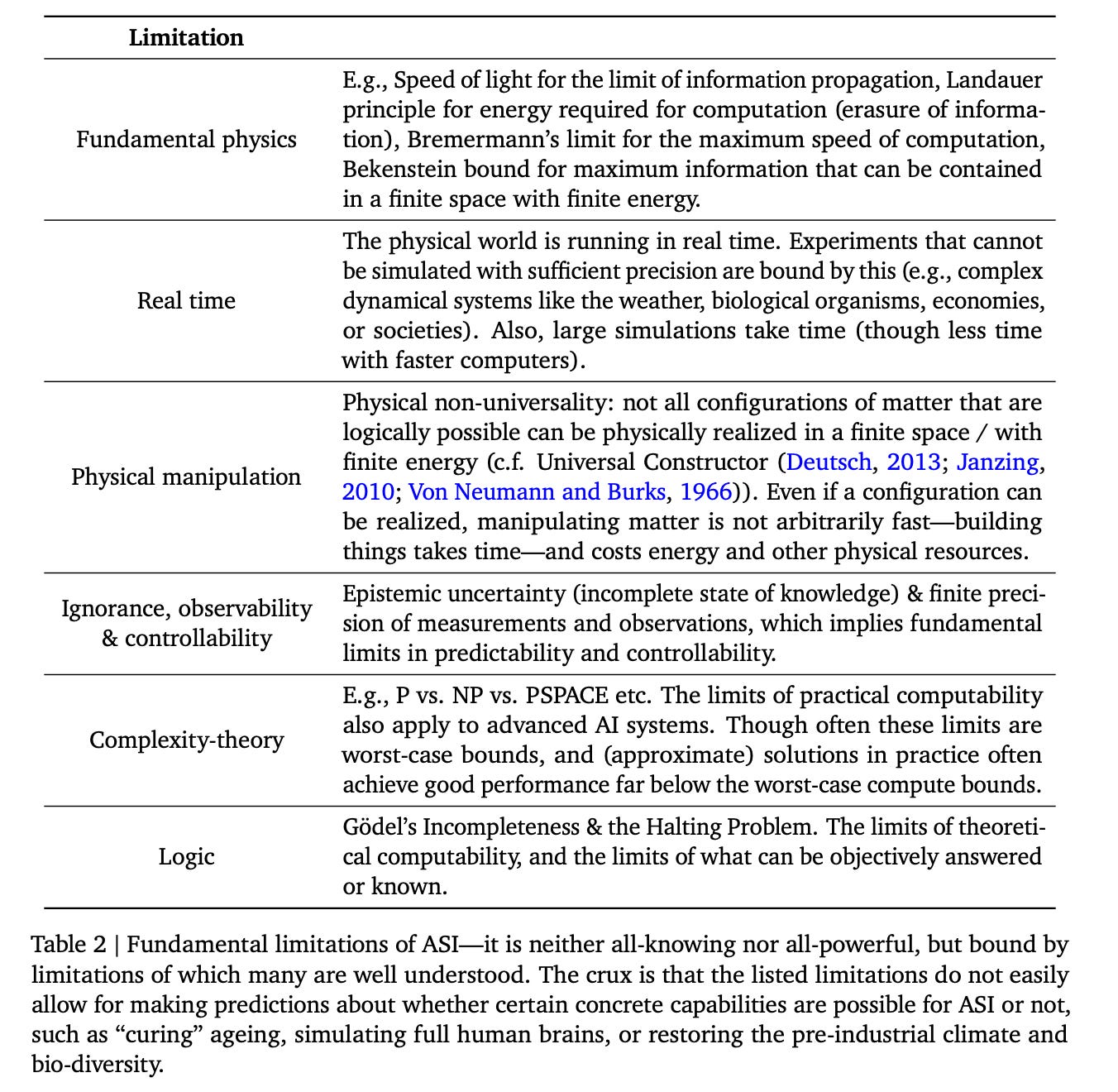
What about unforeseen risks on the path to ASI? There are likely plenty I cannot conceive of and the AI safety researchers haven’t thought of yet. I know that I know very little about what could go wrong, and we need to do more balanced work here, grounding any optimism about growth and abundance with safety planning and simulations. Also note that ASI is not magic - it will have limits we will have to probe and understand.
ASI Implications for Today - How to Prepare (2026)
Align yourself with a society that is closest to AGI to ASI takeoff: Pragmatically, it’s better to be closer to the takeoff edge, given an uneven distribution and takeoff, and that means the US, but more clearly the AI industry in San Francisco. There are large risks to falling off and being left in the periphery. These days, I’d rather be an electrician or even a kindergarten teacher in SF than a highly skilled person in another country that is not AI-pilled. If you can move to California, Texas, or the Greater DC-area (the largest beneficiaries of AI), you probably should.
Join the AI to AGI Economy - Increase your own use of AI systems and AGI along the way: Personally learn to use these systems to effect the change you want and become a centaur to be maximally productive in areas you care about. At a minimum, this means having a Claude Code and Codex account and using both to improve your skills and whatever services you provide to the world.
Make sure most of your investment portfolio is concentrated in a diverse set of AI bets (you can own the S&P500, or just the tech sub-index from Vanguard VGT, or even the MANGO companies). This helps soften the ride from an AGI world to the ASI world, as societies figure out the larger issues of wealth and income distribution.
For many people around the world who just have bank savings or other assets, this means converting half or more of it to own tech stocks - like a Nasdaq ETF or a Vanguard IT index fund (VGT). And for those who aren’t saving, just spending less now on luxuries to build up a transition nest egg.
Prepare your kids for a world of abundance and plenty over 20 years: this means self-discipline, charity, caring for others, having purpose and agency, and cultivating healthy habits and responsibility. Studies show kids from rich families have many problems due to that prosperity, especially substance use, anxiety, and depression. We will have to figure out what successful rich families do to prepare healthy kids, and in some ways that’s a good problem. These rising material standards will hit different countries (and even states and provinces, or cities within countries) differently, and so a solution in Tamil Nadu, India or rural Poland may be very different than SF/NYC or a typical South American city.
Avoiding dying or being pulled into wars: As an individual, do your best to improve your health for a 20-year span to live into the ASI age, where odds are you will get a big boost in health and wealth; as a society, avoid ruinous outcomes like large wars that statistically will kill citizens or reduce lifespans (eg the Russian-Ukraine War or a possible US-China War). War is hellish, irrational and dumb. Avoiding it at almost all costs before we enter the ASI age will be a priority, and forcing AGI or ASIs to run wars will likely backfire.
Great post and I really enjoyed it — only question, which is relatively immaterial, but I’m curious: given you used it as a prominent measure/example, how do you see AI reducing the cost of flying in the relative near-term? New fuels? Electric planes? Lower cost of manufacturing planes? All of these seem solidly medium-term at the soonest.